The Host Who Understands GBA Sees Every Room Differently. Here's What They See.
A Staygineer does not walk into a room and see furniture. They see friction, flow, and behavioral signals, and once you learn to read a space that way, you cannot unsee it.

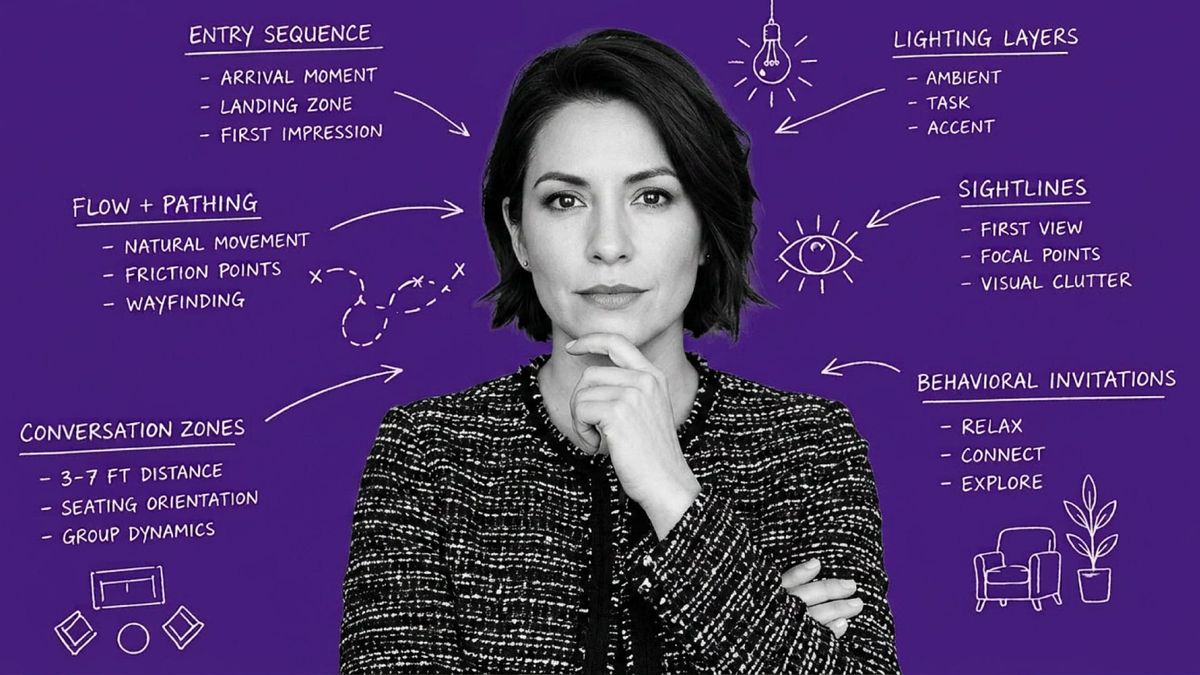
Eleven posts into this series, a specific body of knowledge exists for the reader who has followed it through. Three Laws. Four behavior zones. Four friction types. A three-step process. A diagnostic tool. An intellectual tradition stretching from Walt Disney Imagineering to the specific decisions a host makes about furniture placement and light control in a beach rental on the Texas coast. A complete framework for understanding why some short-term rental stays produce enthusiastic, specific, repeat-generating reviews and others produce politely positive ones that plateau at four stars and stay there.
This post is about what that knowledge looks like when it has been fully internalized. What it does to the way a host sees a room. What it makes visible that was invisible before. What it changes permanently about the standard a host holds their property to and the questions they ask when they walk through it.
The host who understands Guest Behavior Architecture does not walk into a room and see furniture. They see behavioral invitations and friction points. They see communication. They see what the environment is saying and whether what it is saying matches the stay they designed. They see a system, and they see exactly which parts of the system are working and which are not.
This is what that seeing looks like.
The Shift That Cannot Be Undone
The Friction Map post in this series noted that once a host has seen their property documented at the level of precision a Friction Map requires, they cannot return to seeing it through the photographic lens. That observation is true, and it points to something more fundamental: the shift in perception that GBA produces is not a technique you apply. It is a change in how you see.
The host before GBA walks through their property and evaluates it against a photographic standard. Does this room look good? Does this arrangement feel elevated? Would this photograph well from that angle? The host who has internalized GBA walks through the same property and evaluates it against a behavioral standard. What is this zone producing? What is the first thing a guest who has never been here before will do when they enter this space, and does the environment support that? Where is the first moment of uncertainty and what is causing it? What behavior is this furniture arrangement inviting and is that the behavior this zone needs?
Those two walks through the same property produce different information. The photographic walk produces aesthetic assessments. The behavioral walk produces diagnoses. And the diagnostic information is the kind that leads to action, because it is specific enough to act on.
The shift cannot be undone because it is not a frame you put on and take off. It is a change in what you notice. Once you know to look for friction, you find it everywhere — in your own property, in properties you stay in as a guest, in restaurants and hotel lobbies and retail spaces. The trained eye does not turn off. It becomes the default.
What They See in the Arrival Zone
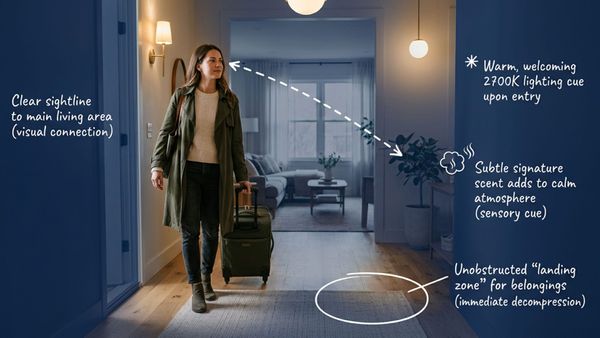
The Staygineer who enters an unfamiliar property begins reading it before they open the door. They notice the approach. Is there a visual anchor on the property that tells an arriving guest they are in the right place? Does the exterior communicate the character of the interior, or does the guest walk from a nondescript approach into a carefully designed space that arrives without any preparation? Is the entry mechanism clear and intuitive, or does it require a guest who is carrying luggage and managing children to also navigate an unfamiliar lock system while standing on an unfamiliar threshold?
Inside the door, the Staygineer is looking for the landing. The place where an arriving guest naturally deposits their things, exhales, and begins to understand the space. A well-designed Arrival Zone makes that landing obvious. There is a surface at the right height for setting things down. There is a clear visual hierarchy that tells the guest where to go next. There is a light level that communicates welcome rather than utility. There is, ideally, a single dominant view or element that orients the guest in the space and gives them the first honest preview of what the stay is going to be.
The Staygineer also notices what is missing. The absence of a landing surface. The entry that opens directly onto a crowded visual field with no clear direction. The lighting that is functional but makes no accommodation for the emotional state of an arriving guest who needs the space to receive them. These absences are not neutral. They are Arrival Zone failures, and the Staygineer sees them immediately because they are looking for what the zone is producing, not what it looks like.
What They See in the Gathering Zone
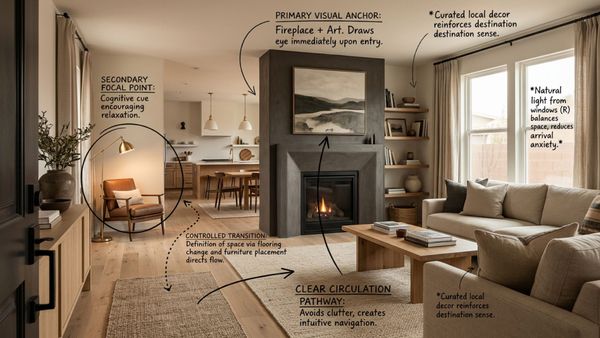
In the main living space and kitchen, the Staygineer is running a behavioral simulation. They are picturing a group of four or six or eight people who just arrived together and are now trying to figure out what to do with themselves. Where does that group naturally want to be? What configuration does the space invite them into? Does the furniture arrangement make it easy for that group to occupy the room together, or does it ask them to distribute in ways that work against the conversation and connection they came for?
They look at the seating and ask whether it is arranged for the listing photo or for an actual group of humans who want to be in the same room together. A sectional positioned to face a television wall is a choice. So is a conversation grouping that allows eye contact between everyone seated. The Staygineer knows which one is serving the Gathering Zone and which one is serving the camera, and they know those two choices are not always the same.
In the kitchen, they are running the cooking simulation. A guest woke up the first morning and decided to make breakfast. What is the first thing they do? Where do they look for coffee? Where do they look for a pan? Is the prep surface clear and available or occupied by things that need to be moved before any cooking can begin? Is the storage logical enough that a person who has never been in this kitchen can find what they need on the first try, or does it require the kind of familiarity that only develops after multiple visits?
They are also looking at the relationship between inside and outside. Does the gathering zone extend naturally to an outdoor space, or does the transition feel like a separate decision? Is the outdoor space visible from inside in a way that creates a pull toward it, or is it something the guest has to remember is there? The Staygineer sees the Gathering Zone as a system that spans indoors and out, and they evaluate the connection between those environments as a behavioral design question.
What They See in the Restoration Zone
The bedroom is where the Staygineer slows down most deliberately, because the Restoration Zone is the zone whose failures are most invisible and most consequential. They are not evaluating the bedding for softness or the furniture for style. They are asking a single primary question: can a person sleep here?
Sleep is a behavioral outcome. It requires specific environmental conditions. The Staygineer is checking light control first, because inadequate light control is the Restoration Zone failure that produces the most downstream damage. A guest who wakes at six in the morning because the curtains do not hold against an eastern sun is a guest who is carrying a sleep deficit into every subsequent day of the stay. That deficit compounds. It affects how they feel in the Gathering Zone, how much energy they bring to the Experience Zone, and how they characterize the overall stay when they sit down to write the review.
They are also checking for what they call occupancy residue: the sense that the previous occupant of the space, or the host, is still present in some way. Personal items that belong to the host and were never removed. A bathroom mirror that has the host's preferred products arranged on the counter. A closet with the host's off-season clothing occupying space the guest needs. These are not just clutter issues. They are emotional friction points that interrupt the guest's ability to fully inhabit the space as their own for the duration of the stay. The Staygineer sees them as behavioral problems, not organizational ones.
They are looking at the spatial logic of the room through the eyes of someone navigating it for the first time in the dark. Is there a clear path from the bed to the bathroom? Is there a surface on each side of the bed for the things a person has with them when they sleep? Is there enough flexibility in the light sources to accommodate the different states of the room — bright for getting dressed, dim for winding down, dark for sleeping? These questions are not about luxury. They are about whether the Restoration Zone can do the job it exists to do.
What They See in the Experience Zone
The Staygineer approaches the property's distinguishing feature, whatever it is that no other nearby property has in quite the same configuration, with a specific and skeptical question: would a guest who arrived yesterday and has never been here before know this exists, know they are welcome to use it, and know how to use it without asking?
Discovery, permission, and accessibility. Those three conditions determine whether the Experience Zone delivers what it was listed to deliver. The hot tub that is visible from the primary living space and labeled clearly in the arrival guide and requires nothing more than lifting a cover to use has passed the Experience Zone test. The kayaks in the garage that are never mentioned in the arrival guide and require the guest to ask whether they are available and to figure out on their own how to carry them to the water have not.
The Staygineer also notices whether the Experience Zone is set up for the behavior it is supposed to produce or simply set up to exist. An outdoor fire pit surrounded by chairs that face away from each other is an Experience Zone that communicates fire but does not produce the gathering behavior that a fire pit is meant to enable. An outdoor dining area with a table for eight and seating for six creates a quiet friction that the host never intended and the guest will feel without identifying. The Experience Zone is where the most money is often invested and where the behavioral design thinking is most often absent, because the feature itself is assumed to do the work that the design around it actually has to do.
What This Seeing Makes Possible
The host who sees their property this way is not a different kind of person. They are a host who has acquired a specific skill: the ability to evaluate an environment against its behavioral purpose rather than its aesthetic appearance. That skill is learnable. It is what this series has been building toward across twelve posts.
What the skill makes possible is a different quality of decision at every point in the design and management of the property. Not just better decisions in the abstract, but decisions made against the right question. Not how does this look but what does this produce. Not does this seem nice but does this serve the zone. Not would a guest notice this but would a guest's stay be measurably better if this were different.
The host who asks those questions consistently has a property that evolves in the right direction. Each improvement is targeted at a behavioral outcome rather than an aesthetic preference. Each change closes a gap between what the property currently produces and what the stay requires. Over time, the gap narrows. The reviews get more specific. The guests who book describe specific things they did rather than general impressions they formed. The ratings move and stay moved. The repeat bookings increase. The rate premium opens up.
This series has laid the foundation: the laws, the zones, the friction types, the process, the tools, the intellectual tradition, and the shift in perception that ties it all together. What follows in The Environment Series goes deeper into each zone and each design decision within it, with the same rigor and the same standard applied to increasingly specific territory.
The Staygineer sees the room differently. Now you know what they see. The rest of the series is about what to do with it.