What Your Entryway Is Communicating (And Why It Sets the Tone for the Entire Stay)
Before a guest reaches the living room, the stay has already begun. In the first thirty seconds, scent, light, sightline, and landing shape how every moment that follows will be interpreted.

The guest experience does not begin when the guest walks through the door. It begins before they get there, in the listing photographs and the booking confirmation and the anticipation that builds between those two moments. But the first time the physical environment speaks directly to the guest, without the mediation of a screen or a platform or a carefully worded description, is the moment the door opens.
That moment is the entryway. And what happens in it matters more than most hosts realize, for a reason that is rooted in how human perception works.
The first signal a new environment sends does not arrive as information. It arrives as a feeling. The guest does not analyze the entryway and render a verdict. They receive it and form an impression, and that impression becomes the emotional lens through which they interpret every subsequent experience in the property. A strong first signal in favor of the stay is forgiving of minor friction later. A weak or negative first signal makes the guest more sensitive to everything that follows. The entryway sets the tone. Once set, it is difficult to change.
This post takes the entryway apart in detail, element by element, to show exactly what it is communicating and what each communicative element produces in the arriving guest.
The First Moment Is Not the Door. It's Before the Door.
The Arrival Zone, as defined in this series, begins before the guest enters the property. It begins at the point of approach: the parking situation, the path from the vehicle to the door, the exterior of the property as it presents itself to someone arriving for the first time. All of that is communicating before the door is touched.
A property that is easy to approach and park communicates competence. The host thought through the practical mechanics of arrival. A property where guests have to circle and problem-solve before they have set down a bag communicates the opposite. It introduces friction at the first possible moment and puts the guest into a problem-solving state when they should be transitioning into a rest state.
The path from the vehicle to the door communicates care or its absence. A path that is clear, well-lit at the times guests are likely to arrive, and free of the kind of ambiguity that makes a first-time visitor wonder whether they are going the right way is a path that serves the arriving guest. A path that is unclear in its routing, dark in the evening, or requires navigating around objects that have no business being in the guest's way is a path that has already spent some of the goodwill the arrival should be building.
The exterior of the property communicates quality, consistency, and whether the listing photographs were honest. A guest who arrives and finds a property that looks like its photographs, or better, receives a quiet confirmation that they made a good decision. A guest who arrives and finds a property that looks noticeably different from what they saw, or less maintained than what they were led to expect, receives a quiet doubt that will accompany them inside. That doubt is emotional friction of the most foundational kind: it begins the stay with a gap between expectation and reality.
All of this happens before the door opens. The entryway itself is the next conversation, and it is the most important one.
The Scent
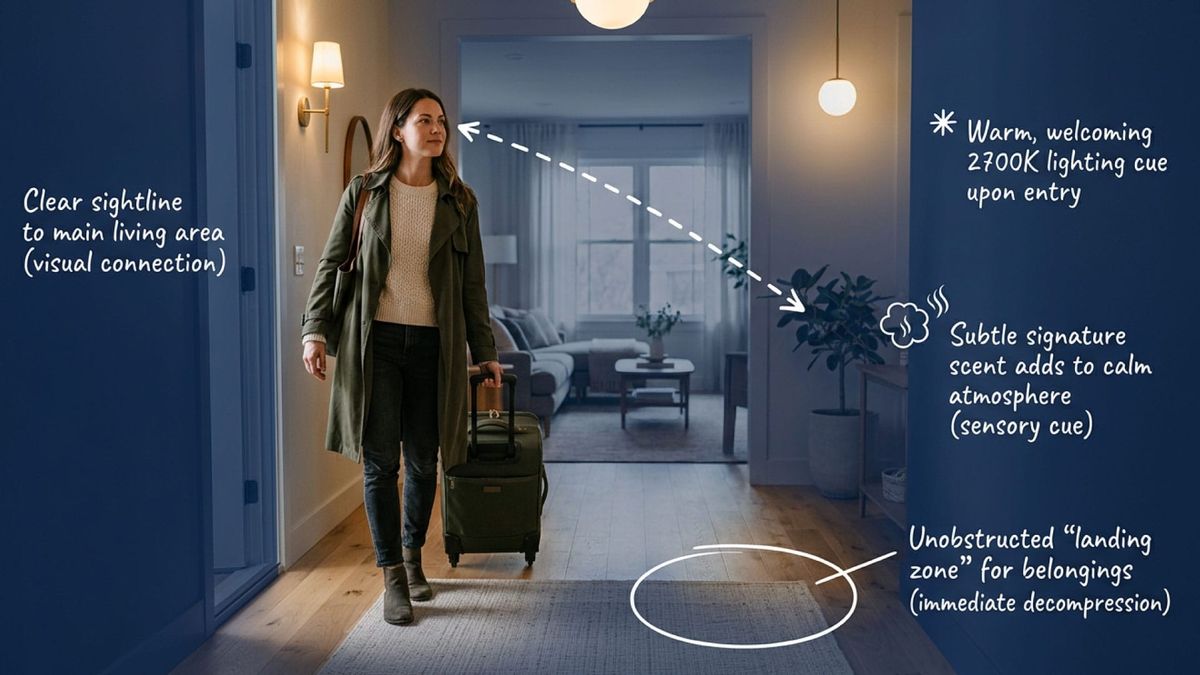
The first sense the entryway engages fully is smell. Not sight, despite what most hosts assume. Sight requires orientation, a moment of processing and interpretation. Smell operates faster. It connects directly to the emotional and memory centers of the brain and produces a response before the conscious mind has time to evaluate what it is responding to. The scent of the entryway is the most emotionally immediate signal the property sends, and it is the one most hosts have never deliberately designed.
There are three conditions a short-term rental entryway can present to the arriving guest through scent, and they produce very different responses.
The property that smells like cleaning products tells the guest it has been cleaned. This is not the same as telling the guest it is clean. Cleaning product scent communicates process: someone was here recently doing maintenance work. It is institutional. It is the scent of a hotel corridor or a commercial kitchen. It does not communicate home, warmth, or welcome. It communicates preparation, which is a step below the experience the guest came for.
The property that smells like nothing in particular is more neutral than it sounds. A complete absence of scent communicates vacancy. It says no one has been here in a while, or that the space has been aggressively neutralized in a way that removes personality along with odor. For some guests, this is acceptable. For most, it is slightly less welcoming than a space with a considered scent character.
The property that smells like something intentional, something that fits the character of the space and the experience it promises, communicates care. Not perfume. Not an aggressive air freshener that announces itself. A subtle, considered scent that says this space was thought about before you arrived and someone made a deliberate choice about how it would receive you. That communication happens in the first breath. It does not need to be significant to be effective. It needs to be right.
Selecting the right scent for a property is not about personal preference. It is about fit. A coastal property and a mountain cabin and an urban loft each have a sensory character that a chosen scent should complement rather than contradict. The scent that communicates correctly in one property is the wrong choice in another. The question is not what smells good in the abstract. It is what scent fits this space and what it tells an arriving guest about the experience they are entering.
The Light
After scent, the entryway's lighting is the next most immediate communicative element, and it operates in two directions simultaneously: it communicates the character of the space and it shapes the guest's emotional state at the moment of arrival.
A dark entryway communicates that the welcome has not started. It says the host did not think about what it would feel like to arrive here after a long drive and step into a space that has not been prepared to receive you. Darkness in a threshold communicates abandonment more than anything else, because the alternative, a space that has been lit in preparation for a guest's arrival, is so clearly the right gesture that its absence reads as neglect.
An overly bright entryway communicates efficiency over hospitality. Bright overhead light at arrival says this is a functional space, not a welcoming one. It is the light of an office or a utility room. It does not say you arrived somewhere you are going to enjoy being.
The light that serves the Arrival Zone best is warm and deliberate. Not dim, because dim communicates neglect of a different kind. Warm and at a level that the eye adjusts to comfortably and reads as considered. A lamp that is on when the guest arrives rather than an overhead light that was switched on at the last moment communicates the difference between a space that was waiting for someone and a space that was prepared for a guest. The lamp says the host thought about the moment of arrival and arranged for it to feel welcoming. The overhead switch says the light was turned on because it was dark.
For properties where guests may arrive after dark, exterior lighting at the threshold is not optional. It is the last line of the approach and the first element the guest encounters at close range. A well-lit front door at nine in the evening communicates safety, care, and welcome simultaneously. A dark threshold at nine in the evening communicates that no one thought about what it would feel like to arrive here after dark.
The First View
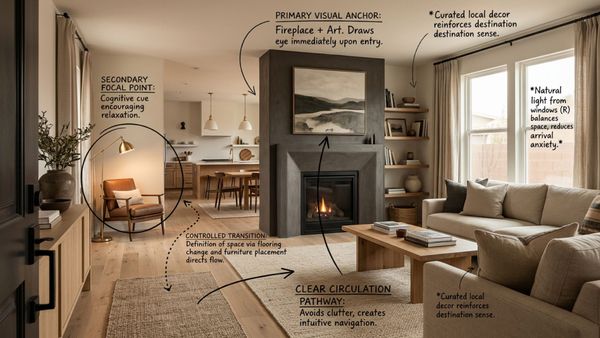
The first interior view is the entryway's primary visual communication, and it is carrying more interpretive weight than most hosts assign to it. When the door opens and the guest steps inside, their eye moves immediately to whatever is most visually dominant in that initial frame. What the eye lands on first communicates what the space is about, what kind of experience is ahead, and whether the property is going to deliver on the version of itself it showed in the listing.
A first view that lands on a well-considered, oriented interior, where a clear visual hierarchy guides the eye into the space and communicates its character accurately and favorably, is a first view that produces confidence. The guest sees what they hoped they would see. The expectation the listing created is confirmed or exceeded. The stay begins in the right emotional register.
A first view that lands on clutter, storage, a utility area, or anything that was not designed to be seen first communicates disorder and the specific disappointment of a space that presents better in photographs than in person. Even if everything else in the property is excellent, a poorly considered first view introduces a moment of recalibration that the guest has to work through before they can begin to settle in.
The most powerful first views are the ones that communicate the property's signature experience immediately. The beach house whose door opens onto a direct sightline to the water. The mountain cabin whose entry frames a view of the treeline. The urban loft whose first interior view establishes the scale and character of the space in a single glance. These first views do not happen by accident. They are designed. The door is placed, or the furniture is arranged, or the wall is removed, specifically so that the most compelling communication the property can make is the first one the arriving guest receives.
Properties that do not have a natural first view that serves this function can create one. A single visual anchor — an intentional piece of art, a designed surface, a carefully positioned element that orients and communicates at the same time — can do the work of a sightline when the architecture does not provide one. The question is not whether a compelling first view is possible. It is whether the host has thought about what they want the guest to see first.
The Landing
The landing is the functional heart of the Arrival Zone and the friction point most consistently missed in short-term rental design. A landing is any surface or configuration that allows an arriving guest to put down what they are carrying, take stock of the space, and begin to orient themselves without having to make a decision about where to put their things before they have any information about where things go.
The absence of a landing is one of the most common Arrival Zone failures a Friction Audit finds. A guest who enters a property carrying bags and a child and a travel bag and a grocery run from the drive and finds nowhere obvious to set any of it is a guest who is immediately solving a logistics problem in a space they have never been in. That problem solving state is the opposite of the arriving state. It is active and slightly anxious rather than settling and releasing. It keeps the guest in the mode of the journey rather than transitioning them to the mode of the stay.
A landing does not require a grand foyer. It requires a surface at the right height, in the right location, that is clearly available for guest use. A console table just inside the door with nothing on it that cannot be moved. A bench with space above it for bags. A coat rack next to a clear surface. The specifics depend on the property. The principle is consistent: the arriving guest needs a place to put things down before they can begin to be somewhere. The landing is that place, and its absence is felt immediately even by guests who could not name what was missing.
The Tone That Follows
The entryway communicates in roughly thirty seconds. Scent in the first breath. Light in the first glance. First view in the first step inside. Landing in the first moment of needing to set something down. That thirty-second sequence sets the emotional register for the entire stay.
A guest whose first thirty seconds communicate welcome, care, competence, and accurate representation of what the listing promised is a guest whose nervous system has begun to settle before they have reached the living room. They are in a receiving state, open to the experience the property is going to provide. The rest of the stay is playing from ahead.
A guest whose first thirty seconds communicate neglect, mismatch, or friction of any kind is a guest whose nervous system has registered a signal that something is slightly off. They may not be able to name it. They will remain slightly more watchful, slightly more critical, slightly less generous in their interpretation of everything that follows. The rest of the stay is playing from behind, and recovering ground in a guest experience is genuinely difficult once it has been lost.
The entryway is thirty seconds of communication that determines the emotional starting point of the entire stay. No other thirty seconds in the guest experience carries more weight. That is not an argument for spending more money on the entryway than on any other part of the property. It is an argument for thinking about those thirty seconds with more care than most hosts currently do.
The First Law says every environment communicates. The entryway is where that communication begins. Getting it right is not design taste. It is the foundational act of Staygineering.